A power bank can be one of the most useful accessories for a smartphone user. Whether you travel frequently, spend long hours outside, use mobile data throughout the day, or simply want an emergency backup, a good power bank can keep your phone running when a wall charger is not available.
The Indian market has a huge variety of power banks, ranging from compact models designed for occasional emergency charging to high-capacity units that can recharge a smartphone several times. There are also models with USB-C Power Delivery, built-in cables, digital displays, wireless charging, and high-wattage output.
Choosing one can therefore be confusing. A power bank with a huge mAh number is not automatically the right choice. Charging speed, actual usable capacity, compatibility with your phone, safety features, weight, and portability all matter.
Current products available in India demonstrate this range. Xiaomi, for example, offers a 20,000mAh model with up to 22.5W charging and a built-in USB-C cable, while its 20,000mAh Power Bank 5i offers up to 67W output with PD 3.0 and PPS support.
Understanding Power Bank Capacity
Capacity is usually the first specification people notice. It is normally shown in milliamp-hours, or mAh. Common smartphone power banks include 5,000mAh, 10,000mAh, 20,000mAh, and larger capacities.
A 10,000mAh power bank is generally a convenient middle ground for everyday smartphone users. It is easier to carry than a 20,000mAh model while still providing enough energy for additional phone charging during a normal day.
A 20,000mAh model is more suitable for people who travel frequently or spend long periods away from electrical outlets. It can provide several charging sessions depending on the smartphone battery, charging efficiency, power-bank output, and other losses.
However, the number printed on the power bank should not be interpreted as the exact amount of energy your phone will receive. Conversion losses occur when the battery’s internal voltage is converted to the voltage used by the phone. Xiaomi, for example, lists its 20,000mAh model with a rated capacity of 12,000mAh at 5V and 3.6A.
10,000mAh or 20,000mAh
The choice between these two capacities depends mostly on how you use your phone.
A 10,000mAh power bank can be easier to carry in a pocket or small bag. It is useful for commuters, students, office workers, and people who mainly want emergency backup power.
A 20,000mAh model is physically larger but provides considerably more stored energy. It can be useful during long journeys, camping trips, workdays away from charging points, or situations where several devices need power.
If portability is your highest priority, a smaller capacity can make more sense. If you frequently need multiple charges, the additional size of a 20,000mAh model may be worthwhile.
There is no single capacity that suits every smartphone user.
Check the Charging Speed
Capacity tells you how much energy a power bank stores, but charging wattage tells you how quickly it can deliver power.
A basic power bank may provide relatively modest output, while newer models can support 20W, 22.5W, 30W, 45W, 65W, or even higher output.
For smartphones, USB Power Delivery, commonly called USB PD, is particularly useful because it is a widely supported fast-charging standard. Some phones can also require additional charging protocols to reach their maximum charging speed.
For example, Xiaomi’s Power Bank 5i 20,000mAh supports up to 67W and includes PD 3.0 with PPS support.
This does not mean that every smartphone connected to it will charge at 67W. The phone determines how much power it can accept, and the charging protocol must also be compatible.
Match the Power Bank to Your Phone
Before buying a high-wattage power bank, check your smartphone’s maximum supported charging speed and charging standard.
If your phone supports 25W charging, buying a power bank capable of 100W output does not automatically make the phone charge at 100W. The smartphone controls the charging process.
Similarly, a power bank advertised with a particular fast-charging technology may not provide the maximum advertised speed to every device.
For this reason, look at both specifications rather than considering the power bank’s maximum output by itself.
Users with phones from Samsung, Xiaomi, Redmi, Motorola, OnePlus, Vivo, Oppo, Realme, Apple, and other brands should check their specific model’s charging requirements before purchasing.
USB-C Is Important
USB-C has become increasingly important for modern smartphones and accessories.
A power bank with USB-C input and output can be more convenient because the same type of connector can often be used to recharge the power bank and charge compatible devices.
Some newer models also include built-in USB-C cables. Xiaomi’s 20,000mAh compact power bank, for example, includes an integrated USB-C cable and supports USB-C input and output.
A built-in cable can reduce the number of accessories you need to carry, although a detachable cable can be easier to replace if it becomes damaged.
If your phone uses USB-C, a USB-C power bank is generally a practical choice for everyday use.
Look for USB Power Delivery
USB Power Delivery is particularly useful for people who want a versatile power bank.
PD allows compatible devices and chargers to negotiate an appropriate level of power. Depending on the power bank, it can support smartphones, tablets, and sometimes laptops.
Belkin’s current power-bank range, for example, includes USB-C PD models ranging from smaller capacities to 25,000mAh units designed for phones and larger devices.
A power bank with PD can therefore be more useful if you own several devices with different charging requirements.
For smartphone-only use, however, there is no need to buy an extremely high-wattage model if your phone cannot use the additional power.
Consider PPS Compatibility
PPS stands for Programmable Power Supply and is an extension of USB Power Delivery technology.
Some smartphones use PPS to achieve their supported fast-charging speeds. Samsung Galaxy devices are one example where compatible PPS charging can be relevant.
If your phone specifically supports PPS, choosing a power bank that supports both PD and PPS can provide better compatibility.
Xiaomi’s Power Bank 5i 20,000mAh is one current example that supports PD 3.0 with PPS.
Always check the specifications for your exact smartphone rather than assuming that every PD power bank supports every fast-charging system.
Safety Features Matter
A power bank contains a rechargeable lithium-ion battery, so safety should be treated as an important purchasing factor.
Quality models commonly include protections against overcharging, over-discharging, overcurrent, overheating, and short circuits.
Xiaomi’s current 20,000mAh power bank lists 12 layers of circuit protection, including temperature protection, overcurrent protection, overvoltage protection, short-circuit protection, and overcharge and over-discharge protection.
Belkin also lists multiple safety protections on its current power-bank products, including overheat and overvoltage protection.
This is one reason it is better to purchase a power bank from a reputable manufacturer rather than choosing an unknown product solely because it offers an unusually large capacity at a very low price.
Avoid Extremely Cheap Unknown Power Banks
Price is important, but an unusually cheap power bank claiming an enormous capacity should be treated carefully.
Some low-quality products can exaggerate their capacity or charging performance. Poor-quality battery cells and inadequate protection circuits can also create reliability and safety concerns.
A reputable manufacturer should provide clear specifications, warranty information, charging ratings, and safety information.
Look for details such as rated capacity, input and output specifications, supported protocols, battery type, warranty, and manufacturer information.
A slightly more expensive power bank from an established brand can provide greater confidence than a suspiciously cheap product with unclear specifications.
Built-In Cable or Separate Cable
Power banks are available with both built-in and detachable cables.
A built-in cable is convenient because you do not need to remember to carry a separate charging cable. Xiaomi’s 20,000mAh compact model uses this approach and includes an integrated USB-C cable.
The disadvantage is that the cable is permanently attached. If it becomes damaged, replacing the entire power bank may be necessary depending on the design.
A detachable cable provides more flexibility. You can use different cables for different devices and replace a damaged cable without replacing the battery.
For someone who owns several devices, a power bank with separate USB-C ports may therefore be more versatile.
Multiple Ports Can Be Useful
If you regularly carry a smartphone, smartwatch, earbuds, or another device, multiple output ports can be useful.
Some power banks allow several devices to charge simultaneously. Xiaomi’s 20,000mAh model, for example, has three charging connections and supports simultaneous charging, although output is shared according to the device and port requirements.
However, charging several devices simultaneously may reduce the maximum output available to an individual device.
If you normally charge only one phone, multiple ports may not be necessary. For families or frequent travelers, they can be much more convenient.
Digital Battery Displays
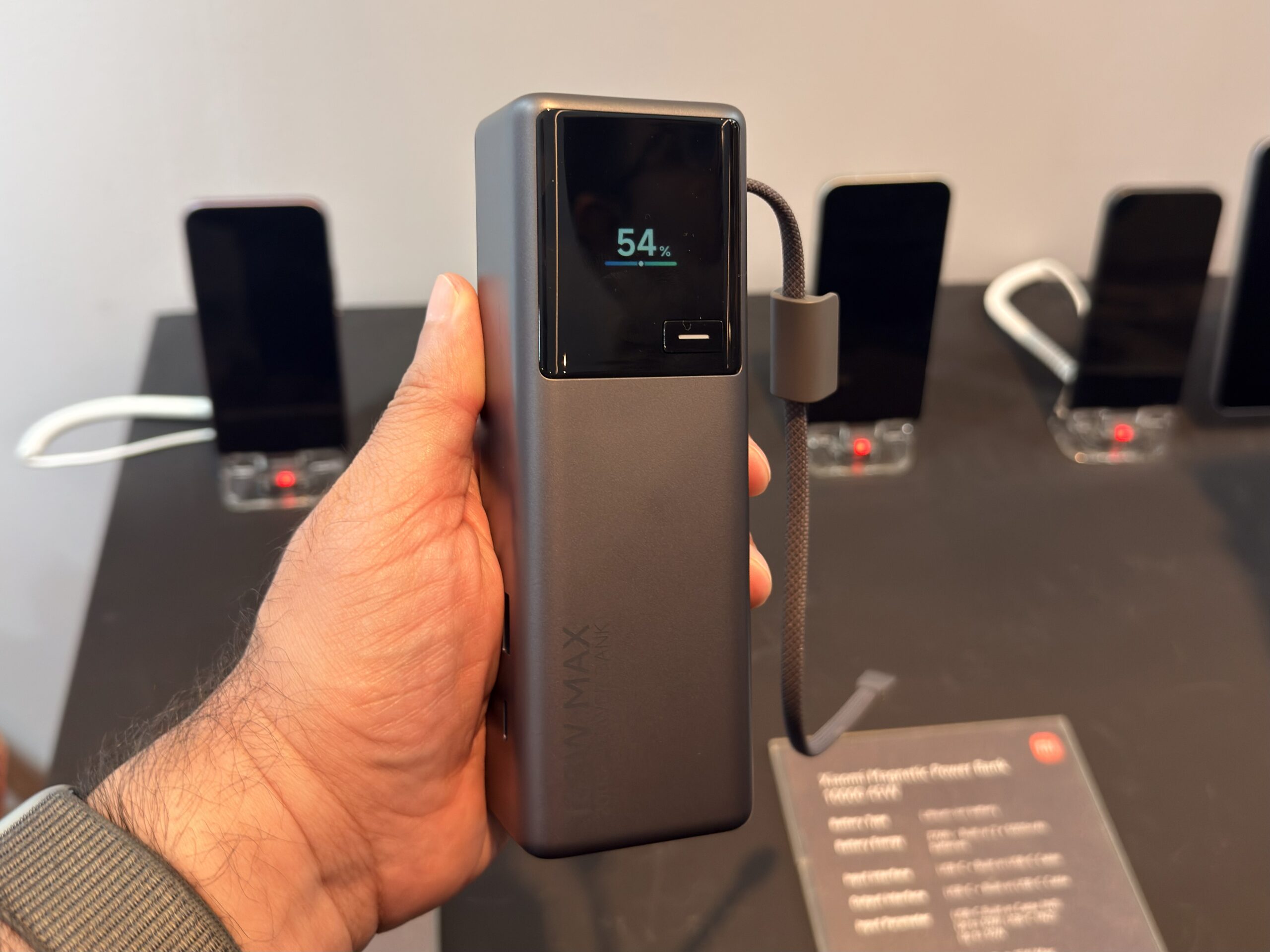
Some power banks use a row of LED indicators to show approximate remaining battery levels. Others include a digital display that shows a percentage.
A digital display can make it easier to understand how much charge remains.
This can be particularly useful with larger power banks because four simple LEDs may not provide enough information for someone who wants to know whether the battery is at approximately 25 percent or 40 percent.
However, a display is a convenience feature rather than an essential requirement. The charging capacity and safety of the power bank are more important.
Wireless Power Banks
Wireless power banks can charge compatible smartphones without a cable.
Magnetic wireless models are particularly convenient for compatible phones because they can attach to the back of the device. Belkin’s current range includes magnetic power banks using Qi2 and MagSafe-compatible technology, with capacities ranging from 2,500mAh to 10,000mAh.
Wireless charging is convenient, but wired charging is generally the more efficient option for quickly transferring power.
Wireless models can also be more expensive for the same nominal capacity. They make the most sense for users who value convenience and have a compatible smartphone.
Think About Size and Weight
Capacity is not the only factor that affects portability.
A 20,000mAh power bank will generally be larger and heavier than a 10,000mAh model. If you carry it in a pocket every day, the extra size can become noticeable.
A larger power bank can be worthwhile for travel or long workdays, but a smaller model may be more practical for everyday emergency charging.
Think about where you will carry it before buying. A product that remains at home because it is too heavy does not provide much value when your phone battery runs low outside.
Power Banks and Air Travel
If you travel by airplane, check the power bank’s watt-hour rating and the airline’s current rules before flying.
Xiaomi notes that many airline policies limit power banks to a rated energy of no more than 100Wh, while individual airlines can have additional requirements.
For reference, a 10,000mAh power bank at a nominal 3.7V is approximately 37Wh. A 20,000mAh model at the same nominal voltage is approximately 74Wh.
This is why many conventional 10,000mAh and 20,000mAh power banks fall below the commonly used 100Wh threshold. Amazon Shipping India’s current lithium-battery guidance similarly uses 100Wh as an important threshold for many lithium-ion transport situations.
Airline policies can change, so travelers should check their specific airline’s latest rules before departure.
Check the Rated Capacity Rather Than Only the Advertised Capacity
Power-bank packaging can show several capacity figures, which can be confusing.
The advertised mAh figure usually describes the battery cells at their nominal voltage. The rated capacity at the power bank’s output voltage can be lower.
This is normal because electrical energy has to be converted before reaching the phone.
Xiaomi provides a clear example with its 20,000mAh Power Bank 5i. The product contains three 6,700mAh cells and lists a rated capacity of 12,000mAh at 5V and 3.6A.
Therefore, do not calculate the expected number of phone charges simply by dividing your phone’s battery capacity into the power bank’s advertised mAh number.
Fast Charging Also Depends on the Cable
A high-output power bank cannot always deliver its maximum speed if the cable is unsuitable.
The cable needs to support the required current and charging protocol. This becomes particularly important with high-wattage USB-C charging.
Xiaomi notes that compatible cables are required for certain fast-charging performance levels on its power banks.
If you buy a 67W power bank but continue using an old cable that cannot handle the required power, your phone may charge at a lower speed.
For high-speed charging, the power bank, cable, and smartphone should all support the required charging standard.
How Much Power Do You Actually Need
For most smartphone users, a 10,000mAh power bank is enough for occasional backup.
A 20,000mAh model makes more sense for frequent travelers, heavy phone users, or people who need several charging sessions.
If you only want enough power to get through an emergency, a small 5,000mAh model may be sufficient. These are easier to carry and can be useful as an everyday backup.
If you also want to charge tablets, cameras, handheld gaming devices, or laptops, you should look beyond capacity and examine the power output. A larger capacity alone does not guarantee that a power bank can charge a particular device quickly.
Features Worth Prioritizing
When comparing power banks in India, several specifications deserve more attention than decorative features.
Capacity should match your daily usage. USB-C input and output improve convenience. USB PD is useful for compatible fast charging. PPS can matter for specific smartphones. Safety protections are essential. A clear warranty adds confidence. Weight and size determine whether the power bank is practical to carry.
A digital display, built-in cable, wireless charging, and multiple ports are useful conveniences, but they should come after the basic charging and safety requirements.
The goal is to find a power bank that works reliably with your phone rather than simply choosing the product with the largest number printed on the box.
How to Choose a Power Bank for Different Users
A student who spends most of the day at college may prefer a compact 10,000mAh model that is easy to carry.
A frequent traveler may prefer 20,000mAh capacity, USB-C PD, multiple ports, and a clear battery indicator.
A user with a fast-charging smartphone should pay particular attention to wattage, PD, PPS, and cable compatibility.
Someone who owns several USB-C devices may benefit from multiple USB-C ports and higher total output.
A user who frequently travels by air should pay attention to the Wh rating and airline restrictions before choosing an especially large battery.
The best choice therefore depends on the devices being charged and how the power bank will be used.
Final Buying Checklist
Before buying a power bank in India, check its advertised capacity and rated capacity, maximum output, USB-C support, PD and PPS compatibility, number of ports, safety protections, dimensions, weight, warranty, and manufacturer reputation.
Also check whether your smartphone can actually use the advertised charging speed. There is little benefit in paying extra for extremely high output if your phone cannot accept it.
For everyday smartphone use, 10,000mAh and 20,000mAh models cover many practical situations. A 10,000mAh model is easier to carry, while a 20,000mAh model provides more stored energy for longer trips and heavier use.
Modern power banks can do much more than simply store emergency battery power. USB-C, fast charging, PD, PPS, built-in cables, digital displays, wireless charging, and improved safety systems have made them more versatile accessories for smartphones and other portable devices.
The most important step is to choose according to your actual needs. A reliable power bank with appropriate capacity, compatible charging standards, good safety protection, and a practical size can be much more useful than a model chosen solely because it advertises the highest mAh number.